The Tree That Already Did Its Job

There is a particular kind of tree that grows across the smallholder farms of North Sumatra and much of Southeast Asia. It is not planted for its timber. It is planted for what it produces while it is alive — latex, tapped from its bark season after season for twenty-five to thirty years.
When a rubber tree stops producing latex, it has reached the end of its agricultural purpose. The farmer replaces it. A new cycle begins.
The question that interested us was a simple one: what happens to the wood?
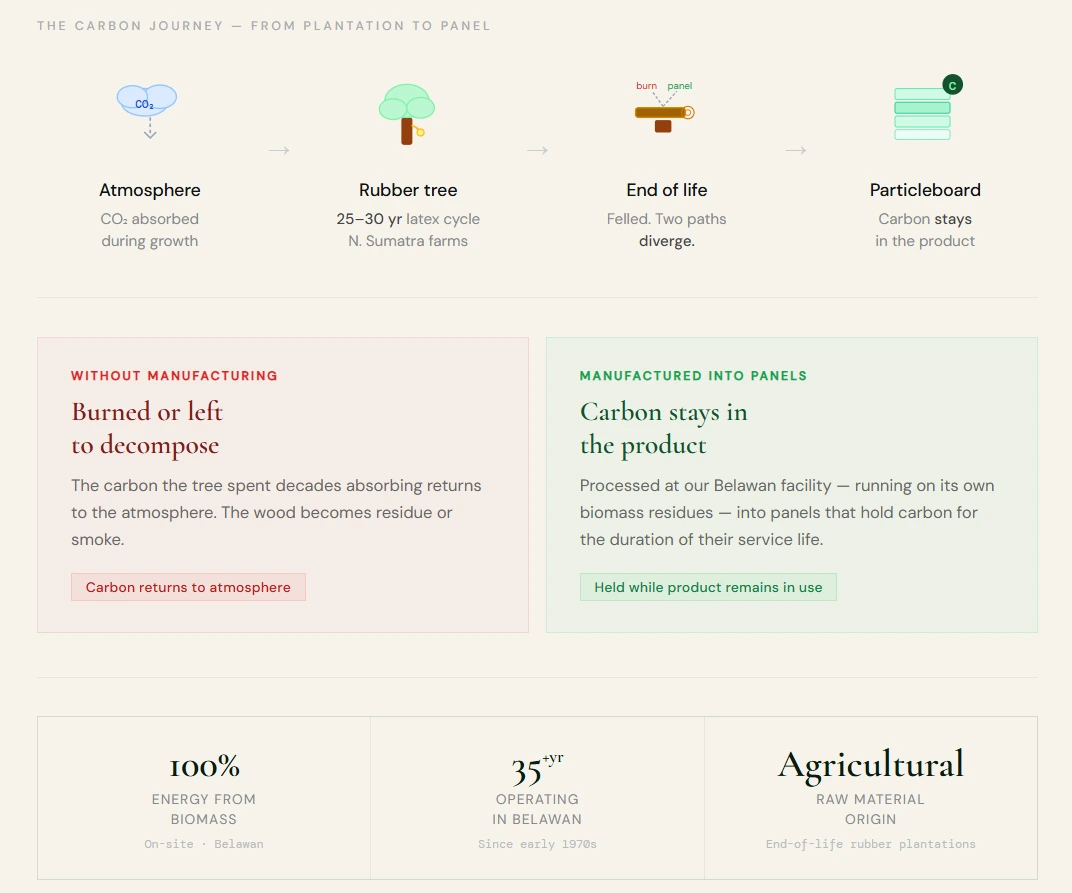
In the past, the answer was often burning or leaving it in the field. The wood decomposed. The carbon the tree had spent decades drawing from the atmosphere made its way back.
What happens when that wood is processed into a panel instead is different — not in terms of what the tree did, which is already done, but in terms of what comes next. The carbon stays in the product. In the panel sitting inside a piece of furniture or a fitted room. For years, and in many cases for decades.
We are not making a claim about what we have prevented. We are describing what happens physically when agricultural residue wood becomes a durable manufactured product rather than returning to the field.
At Canang Indah, rubberwood has been central to what we do in Belawan for over thirty-five years. It arrives from the surrounding agricultural landscape. It is processed in a facility that runs on the residues of its own production — bark, wood dust, offcuts — as fuel. The system has a coherence to it that developed over time, not by design for any particular market, but because it made sense where we are.
What has changed is the language available to describe it.
The IPCC, ISO, and European standards that govern carbon accounting in manufactured wood products have established methodologies for quantifying what is stored in a panel, how long it tends to remain there, and how to represent it in a verifiable way. These are not new sciences. They are the application of established principles to a category of product that has, until recently, sat outside the main discussion about carbon in industrial supply chains.
We have spent the past year working to understand where rubberwood-based particleboard fits within those frameworks. Not to make claims we cannot support, but to build documentation that reflects what is actually happening — from the origin of the raw material, through the production process, to the product that leaves our factory gate.
There are limits to what can be said with certainty. Standards are still developing. The treatment of biogenic carbon in supply chain reporting is an active area of work internationally. We are working within those realities, not around them.
What we can say is that the material has a story worth understanding. Rubberwood is an agricultural byproduct. It enters our production at the end of one useful life and becomes something with another. The carbon it holds has a residence time that can be measured. The energy used to process it comes from the process itself.
These are not marketing positions. They are characteristics of a material and a system that we think deserve to be understood more clearly — by the buyers who source from us, by the frameworks developing around supply chain accountability, and by the broader disucssion about what sustainable manufacturing actually looks like in practice.
We are at an early stage of that work. But we think it begins here, with the tree that was already doing something useful long before anyone was counting it.